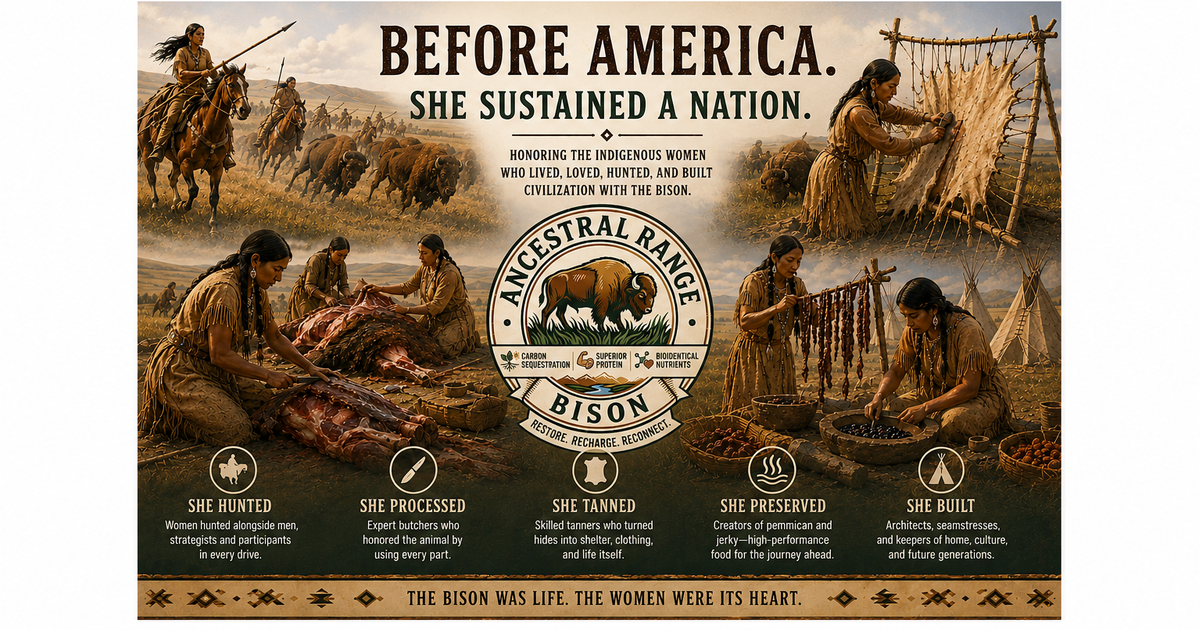
When most people picture a Plains bison hunt, they see a single image: a man on horseback, lance raised, charging into a thundering herd. That image — immortalized by artist George Catlin in the 1830s — became the dominant story of Indigenous peoples and the bison. It was dramatic. It was photogenic. And it captured maybe ten percent of what actually happened.
The bison hunt was never a men’s event with women waiting at camp. It was a fully integrated community operation — and once the animal fell, the preponderance of skilled, technically complex, and physically demanding labor shifted squarely onto women’s shoulders. As someone building a bison operation rooted in ancestral knowledge, I think it’s past time we told that part of the story.
“The northern Great Plains were once the realm of Indigenous women — as harvesters and hunters.”
— Rosalyn LaPier (Blackfeet/Métis), Environmental Historian, University of Illinois — PBS/Ken Burns, The American Buffalo
PHASE 1 — BEFORE THE KILL
The Ecological Intelligence That Made Hunts Possible
Indigenous women were the primary knowledge keepers of grassland ecology and anthropogenic fire management on the Great Plains. They understood which grasses attracted bison in which seasons, how controlled burns could concentrate herds, and how landscape features could be leveraged for a drive. This wasn’t passive knowledge. It was the strategic intelligence that determined whether a community would eat.
Women also participated directly in the drives themselves. In Blackfoot tradition, women constructed curved fences from travois tied together to funnel game toward waiting hunters. In large cliff-jump operations, women formed part of the human drive line — coordinating the movement of hundreds of animals. One successful drive could yield 700 bison.[1,2]
PHASE 2 — AT THE KILL SITE
Speed, Skill, and No Margin for Error
The moment a bison fell, women’s expert work began. A 1,000–2,000 lb animal begins to stiffen and spoil quickly — especially in summer heat. Women moved fast and methodically: removing the hide before it cooled, extracting organs, separating cuts of meat, salvaging every usable part. A 16th-century Spanish soldier named Castañeda documented watching Native women butcher bison and was astonished at their speed and efficiency using simple tools.[1]
While men might help turn an animal over, processing the meat and tanning the hides were primarily — and consistently — women’s domain across Plains nations. This division wasn’t incidental. It was organized, practiced, and ceremonially recognized.[3,4]
10 days
avg. to tan one bison robe
13 hides
needed to build a single tipi
~20 robes
max one woman could trade per season
PHASE 3 — PRESERVATION
The Original High-Performance Food Technology
A single bison produced far more meat than could be eaten fresh. Women were the engineers of preservation. Jerky required precise slicing and controlled smoking or sun-drying. Pemmican — the Plains’ most important survival food — was entirely women’s work: meat was dried, then pounded with stone hammers to near-powder, mixed with rendered fat and dried berries (chokecherries and Saskatoon berries on the Northern Plains), and packed into heavy bison-hide bags holding up to 90 lbs each. Women also gathered the berries themselves — a separate seasonal labor feeding directly into the preservation calendar.[5,6]
Pemmican was calorie-dense, shelf-stable, and portable enough to sustain people through winter and long travel. It was precision-engineered food technology — and women invented and operated it entirely.
PHASE 4 — HIDE PROCESSING
The Most Labor-Intensive Work on the Great Plains
This is where the historical record is most striking. A Lakota oral history preserved by the Smithsonian is direct: “It was traditionally the woman’s task to break down the animal, take down the hide, remove and clean the organs, and do all the processing.”[7]
Brain tanning a single bison hide was a multi-stage, multi-day process:
1. Fleshing — Women scraped every trace of fat and tissue from the hide. If left, it would rot. This also thinned the hide and made it workable.
2. Stretching — The hide was pegged flat to the ground or laced vertically into a four-sided frame to dry under tension.
3. Brain tanning — A mixture of the animal’s brains, liver, soapweed, and grease was worked deep into the hide fibers — repeated over days until the hide was soft.
4. Smoking — Finished hides were smoked over fire to set the tanning, waterproof the leather, and prevent re-stiffening when wet.
One woman could produce roughly ten finished robes per season — the upper bound of what was possible while also managing all other aspects of camp life. Trader records from the American Fur Company around 1845 confirm this ceiling was real.[8]
PHASE 5 — ARCHITECTURE & MATERIAL CULTURE
A Woman’s Property. A Woman’s Architecture.
The tipi — one of the most sophisticated portable structures ever devised — was entirely women’s domain. Women cut the lodgepoles, hauled them, engineered the cover, and hand-stitched irregular bison hides together with sinew thread into a precisely shaped, aerodynamically stable shelter. They held the mental blueprint entirely in their heads, with no written patterns, executing a roughly 20-foot-diameter structure by hand.
A standard family tipi required 13 hides. The larger society lodges required up to 30. A tribe of 6,000 people needed approximately 25,000 hides every 3–5 years for tipi maintenance alone.[9] The tipi belonged to the woman who built it — her husband moved into her home.
Beyond tipis, women processed sinew into thread and bowstrings; shaped bones into needles, awls, and scraping tools; cleaned organs for waterproof containers; rendered fat for cooking and lamp fuel; collected buffalo chips for fire on the treeless Plains; and fashioned horns into spoons, cups, and ladles.[10] Every material object the community used passed through women’s hands.
“The buffalo gave us everything we needed. Without it we were nothing… His horns were our spoons, the bones our knives, our women’s awls and needles. Out of his sinews we made our bowstrings and thread.”
— John (Fire) Lame Deer, Oglala Lakota — Lame Deer: Seeker of Visions, 1972
THE LABOR COMPARISON
What Men Did — And How the Balance Looked
Men’s hunting labor was genuinely dangerous. Pre-horse, hunters disguised themselves in bison hides to approach herds on foot. Post-horse, mounted hunting at full gallop among thousands of animals meant downed horses, gorings, and real risk of death. Men produced weapons — arrows, bows, lances — requiring skilled craftsmanship. They conducted raids, held diplomatic roles, and participated in ceremonies that governed the hunt’s spiritual dimension.
But the labor calculus was not equal. A single organized hunt produced dozens to hundreds of animals. Men’s active hunting work at a kill site might span hours. Women’s processing work from that same event could span weeks to months. The ratio of post-hunt processing time to hunt time was enormous — and virtually all of it fell to women. When the 19th-century fur and robe trade surged, it was women’s tanning labor — not men’s hunting — that became the actual production bottleneck.
WHY THIS WAS ERASED
The Deliberate Distortion of Colonial Documentation
Colonial-era documentation of Plains life was conducted almost entirely by European and American men, observing through a lens that foregrounded the dramatic — men on horses, weapons, combat — and categorized women’s labor as mere “domestic chores.” The U.S. and Canadian governments then actively worked to change traditional Indigenous gender roles to match what they called “civilized” divisions of labor imported from European culture.[11] Reframing women’s sophisticated technical and economic expertise as housework was not an oversight. It was strategy.
What we are reclaiming now — through Indigenous scholarship, oral history, and bison revival work led by tribes across the Plains — is a more honest picture. As one Smithsonian contributor put it: it is not the individual roles that matter most, but the collaborative nature of the community that made all of it possible.[7]
At Ancestral Range, we raise bison and render tallow as a continuation of a tradition carried primarily by women for thousands of years. When we talk about zero-waste, about using the whole animal, about bison as a complete living system — we are not speaking metaphorically. We are describing what our ancestors knew. The animal and the woman’s labor together were the entire economy. We’re honoring that.
#AncestralRange #BisonNation #IndigenousAgriculture #NativeWomen #RegenerativeRanching #FoodSovereignty #ColoradoFarmer #LandStewardship
SOURCES & FURTHER READING
1. Wikipedia — American Bison Hunting: en.wikipedia.org/wiki/American_bison_hunting
2. Wind River Tribal Buffalo Initiative — “The Role of Native American Women in Plains Tribes”: windriver.org/the-womens-role
3. University of Northern Colorado / Hewit Center — “Women’s Work” (Colorado Indians Series): unco.edu
4. Benjamin Lee Bison — “Plains Culture in the Bison Era”: benjaminleebison.com
5. Hungry for History — “How to Make Pemmican”: hungry4history.com
6. Native American Netroots — “Ancient America: Eating a Buffalo”: nativeamericannetroots.net
7. Smithsonian Folklife Festival / PBS Ken Burns The American Buffalo — “Reviving the Sacred Bond”: festival.si.edu
8. National Park Service — “Hunting and Processing Bison Robes” (Bent’s Old Fort): nps.gov
9. Quora / professional tanner Ray Fetzer research on tipi hide counts and labor
10. Wind River Buffalo Initiative — “Horn to Hoof: The Many Uses of Buffalo”: windriverbuffalo.org
11. Study.com — “Native American Peoples & Buffalos”: study.com